AI in Marketing
AI Visibility: How to Track Whether ChatGPT, Gemini and Perplexity Mention Your Brand
AI visibility shows whether ChatGPT, Gemini and Perplexity mention your brand, in what position and with which sources. Here is how to measure it, build a fair prompt set and turn LLM tracking into a routine.
 Hakan Sancak · 11 min read
Summarize with AI
Contents 10 sections
- What AI visibility means for a brand
- The metrics that matter
- How to build a prompt set
- Run checks the way real users see them
- Verify that the brand really appears in the answer
- Reading competitors, head to head and discovered brands
- Sources and opportunity pages
- A weekly or monthly AI visibility routine
- How Meerkads' AI Visibility (LLM) Tracker handles this
- FAQ
A growing share of buying research now starts with a question typed into ChatGPT, Gemini or Perplexity instead of a search box. When someone asks "what is the best running shoe for flat feet" or "which agency software should a small team use", the answer names a handful of brands and skips the rest. AI visibility is the measure of whether your brand is one of the names that gets mentioned, where it appears in the answer, how it is described and which sources the AI leaned on to say it.
None of that shows up in Google Search Console or GA4, and answers differ by engine, country, language and week. This guide covers what to measure, how to build a prompt set that gives you honest numbers, how to read competitor and source data, and how to turn LLM tracking into a routine your team or your clients will actually use.
What AI visibility means for a brand
In classic SEO you track a position on a results page. In an AI answer there is no page of ten blue links. There is one block of text that may recommend three brands, compare two, or explain a category without naming anyone. So AI visibility has a few layers:
- Presence: does your brand appear in the answer at all?
- Position: are you the first brand named or the fifth?
- Framing: is the description positive, neutral or negative, and is it accurate?
- Sources: which websites did the engine cite, and is your own site among them?
Each engine draws on different sources and cites them differently. Google documents how its own AI features select and link to content in its Search Central guidance on AI features, but no engine gives brands a report on how often they are mentioned. That gap is why AI visibility tools, also called AI brand monitoring tools, exist.
The metrics that matter
Raw mention counts shift whenever prompts or engines change, so ratios are more useful. These five cover the picture:
| Metric | What it measures | Question it answers |
|---|---|---|
| Visibility | Share of answers that mention your brand | How often do we show up? |
| Share of voice | Your share of all brand mentions across answers | How much of the conversation do we own? |
| Average position | Which brand number you are when you appear | Are we named first or as an afterthought? |
| Sentiment | A 0 to 100 score for how you are described | Is the framing helping or hurting us? |
| Citation rate | Share of answers that link to your website | Does the AI treat our site as a source? |
Visibility and share of voice can move in opposite directions. If AI answers start naming more brands per question, your visibility can stay flat while your share of voice drops.
Citation rate deserves attention: a mention without a citation means the AI learned about you elsewhere, such as a review site or forum, and the user gets no direct path to your site.
Why branded and non-branded prompts must be separated
If you ask "is [your brand] good for X?", the answer will mention you almost every time. That inflates visibility and makes every competitor look weak by comparison. Branded prompts are still useful for checking how engines describe you and what they get wrong.
But a fair picture of your competitive position comes from non-branded prompts, the questions a buyer asks before they have a shortlist. Keep the two sets apart in every report, and default to non-branded numbers whenever you compare yourself against competitors.
How to build a prompt set
Your prompt set is the sample you measure. A sloppy sample produces numbers that look precise but mean little. Build it in three layers.
Start with topics
List the themes where you want to be recommended: product categories, use cases, problems you solve, buyer segments. A skincare brand might pick "sensitive skin moisturizer" or "vegan sunscreen"; an agency might choose "PPC management for ecommerce". Ten to fifteen topics is plenty for most brands, and it keeps reports readable.
Mix prompt types
For each topic, write questions that mirror how real people ask. Four types cover most intent:
- Recommendation: "What are the best vegan sunscreens for daily use?" These carry the most commercial weight.
- Information: "How do I choose a sunscreen for sensitive skin?" Brands appear here when the AI uses them as examples.
- Comparison: "Brand A vs Brand B for oily skin?" These show how you are positioned against specific rivals.
- Brand: "Is Brand A cruelty free?" These reveal accuracy and sentiment about you.
Write prompts in natural language, at the length a person would type, often with context like budget or team size.
Keep it stable
Trends only mean something if the sample stays roughly the same. Add prompts when you launch a product or enter a market, but avoid rewriting the whole set every month.
Run checks the way real users see them
Two settings decide whether your LLM tracking reflects reality or a lab version of it.
Web search on. Most consumer AI answers today blend model knowledge with live web results. If you query a model without search, you measure what it memorized during training, which can be months old and lacks citations. With search on, you see the current answer and the sources behind it, which is what your buyers see.
The right country and language. "Best project management software" asked from Germany in German returns different brands than the same question from the US in English. Local retailers, local review sites and local competitors change the answer. If you sell in several markets, track each one separately rather than assuming the US English answer applies everywhere.
Verify that the brand really appears in the answer
Automated analysis of AI answers uses another AI model to read the response and extract brands, positions and sentiment. That step can go wrong. Models sometimes list a brand that is not in the text, merge two similarly named companies, or produce a confident name for a brand that does not exist at all.
A reliable AI visibility tracker therefore checks the extraction against the actual answer text: if the brand name or one of its known spellings is not in the answer, it should not count as a mention. Register your spelling variants (with and without a space, abbreviations, local transliterations) up front so real mentions are not missed either.
Reading competitors, head to head and discovered brands
Competitor data is where AI visibility becomes actionable.
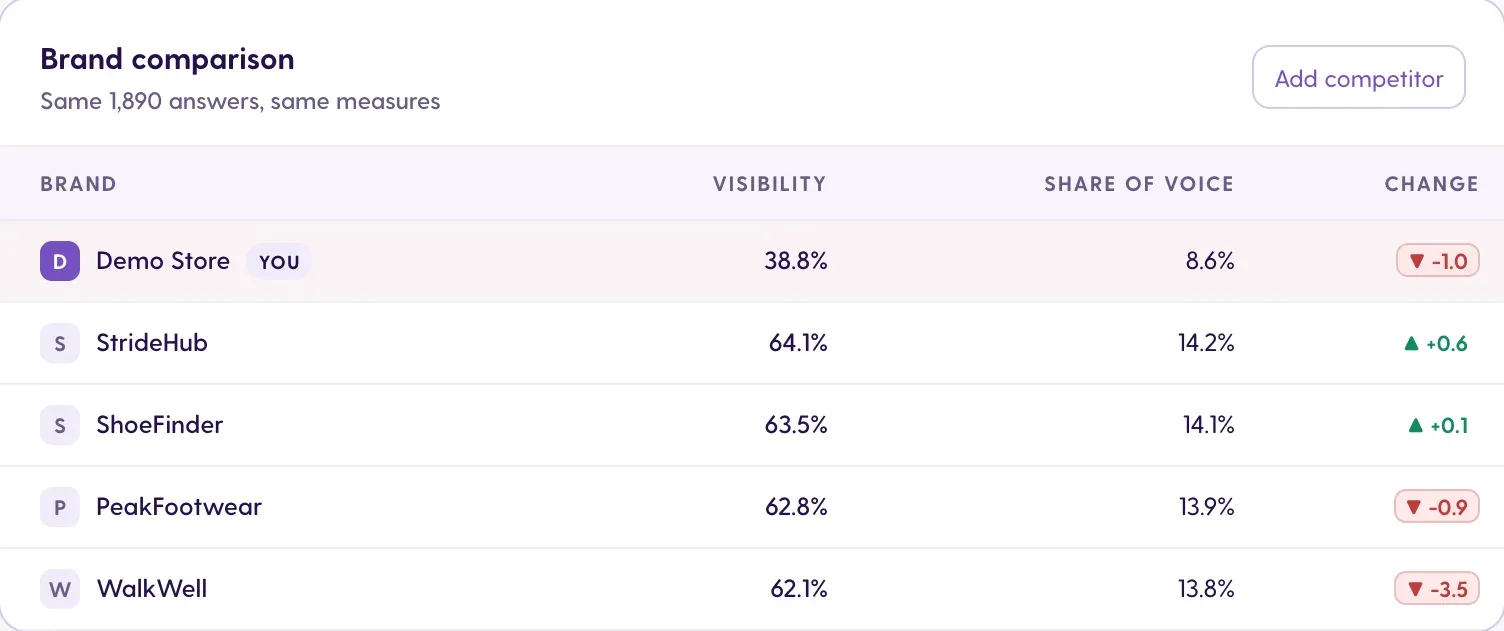
Start with the comparison table: visibility, share of voice, average position and sentiment for you and each tracked competitor, plus the change versus the previous period. Look for the brand that leads on non-branded prompts, since that is the one AI engines treat as the default answer in your category.
Then look at head to head: answers where both you and a competitor appear, and who is named first. If you appear in as many answers as a rival but lose most head-to-head matchups, AI engines know you; the gap lies in how they frame you.
Finally, check discovered brands: names that keep showing up in answers but are not on your competitor list. These are often niche players, marketplaces or newer brands that AI engines like. Some are irrelevant; others are competitors you did not know you had.
Sources and opportunity pages
AI engines with web search cite their sources, and those citations tell you where to act. Group cited domains by type: your own site, competitor sites, marketplaces, forums, stores and media.
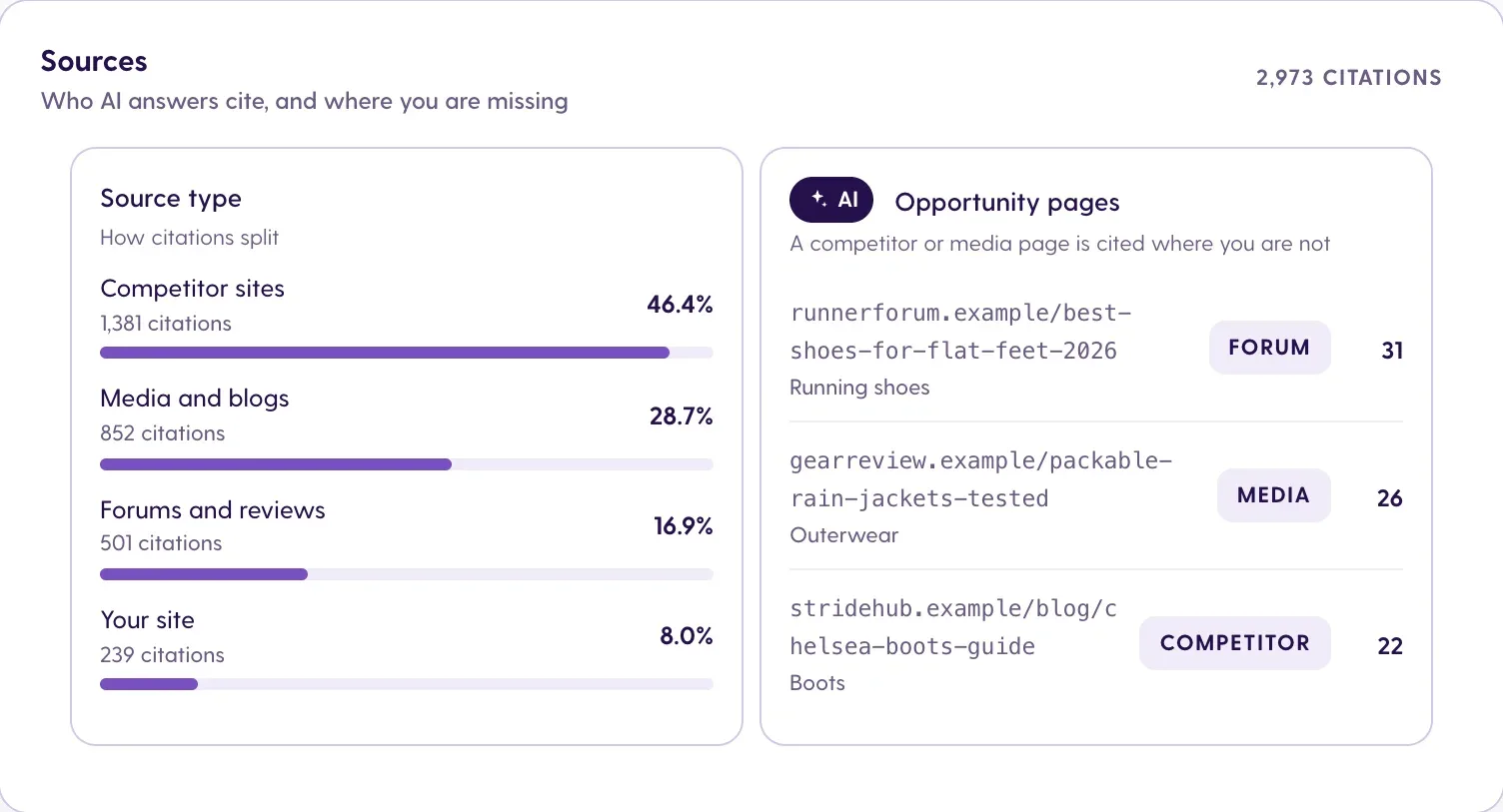
The most practical output is a list of opportunity pages: specific URLs that AI engines cite when they mention a competitor or discuss your category, but that do not mention you. Typical examples are "best of" roundups, buying guides and community threads. Getting included on those pages, through PR, partnerships, product submissions or genuinely useful contributions, is often the fastest way to change what AI says.
Pages on your own site that answer your prompt questions with specific facts give engines something to cite. If you already rank well on Google, our practical GEO playbook covers why ranking pages are sometimes ignored by AI and what to change.
A weekly or monthly AI visibility routine
AI answers fluctuate, so a single check tells you little. A steady routine turns noise into trends.
- Pick a frequency. Weekly for competitive categories, monthly for stable markets, daily during launches or reputation issues.
- Read the summary first. Note your score, the biggest strength, the biggest gap and any new risk such as a negative description.
- Check movement by engine and topic. A drop on one engine in one topic is a targeted problem; a drop everywhere points to something broader.
- Review competitors and discovered brands. Who gained share of voice, and why?
- Pick two or three opportunity pages to work on and log what you did, so you can connect actions to later changes.
- Read a few full answers. Numbers hide inaccuracies about your pricing or features that are worth correcting on your site.
Reporting AI visibility to stakeholders
Keep reports short: non-branded headline metrics, trend, top competitor movement and your actions. Export to PDF for leadership, CSV or XLSX for analysts who want to slice the data. Scheduled email reports keep stakeholders informed without extra work, and a password-protected share link lets clients open the latest numbers without an account. Agencies can report it next to paid media; our PPC report template shows a structure that works well alongside it.
How Meerkads' AI Visibility (LLM) Tracker handles this
Meerkads is an AI-powered performance marketing platform that brings Google Ads, Meta Ads, TikTok Ads, Shopify, GA4 and Search Console into one place. The AI Visibility (LLM) Tracker is a paid add-on that applies the method above to ChatGPT, Gemini, Perplexity, Claude, Google AI Overviews and Google AI Mode.
Setup takes five steps with AI suggestions, and first results arrive in about 25 minutes:
- Brand: name, domain, country, language and spelling variants. The AI reads your site to build a brand profile and runs a quick "how well known is your brand?" pre-test.
- Topics: up to 15.
- Competitors: up to 10, with AI suggestions.
- Prompts: AI writes recommendation, information, comparison and brand questions per topic, all editable, up to 500 active prompts.
- Summary: choose engines, frequency (daily, weekly or monthly) and review the credit estimate.
Every prompt goes to each selected engine with web search on and your country as the location. Tracking is available in Turkish, English, German and Spanish, across Turkey, the US, the UK, Germany, Austria, Switzerland, the Netherlands, France, Spain, Italy, the UAE, Saudi Arabia and Azerbaijan. An AI model analyzes each answer, and the system then verifies in the answer text that each brand really appears, so invented brands are filtered out. Cited domains are classified as your site, competitor, marketplace, forum, store or media.
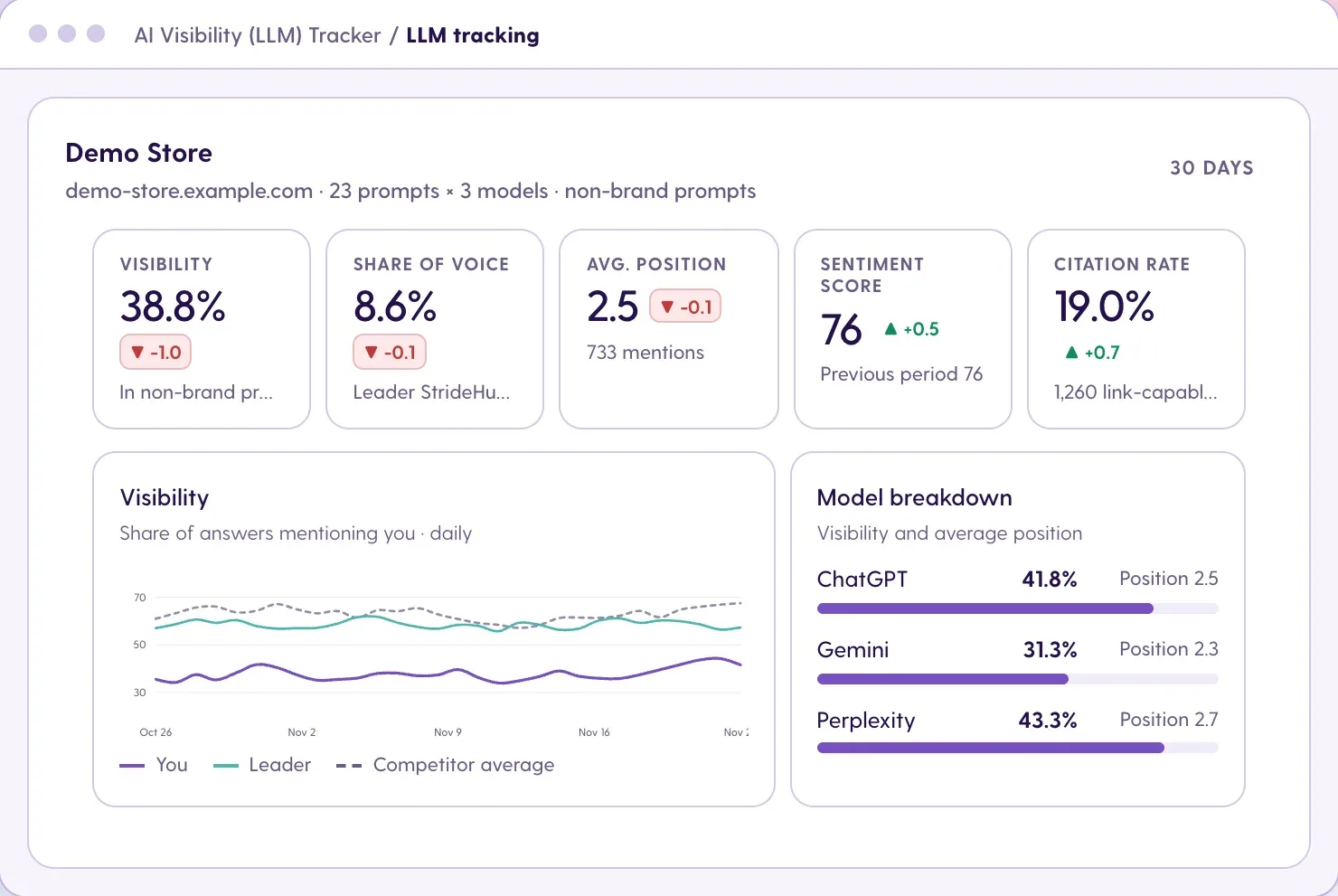
The Overview shows all five metrics, split by branded and non-branded prompts (non-branded by default), a visibility trend comparing you with the leader and the competitor average, a breakdown by engine, a topic by engine heatmap and the most cited domains.
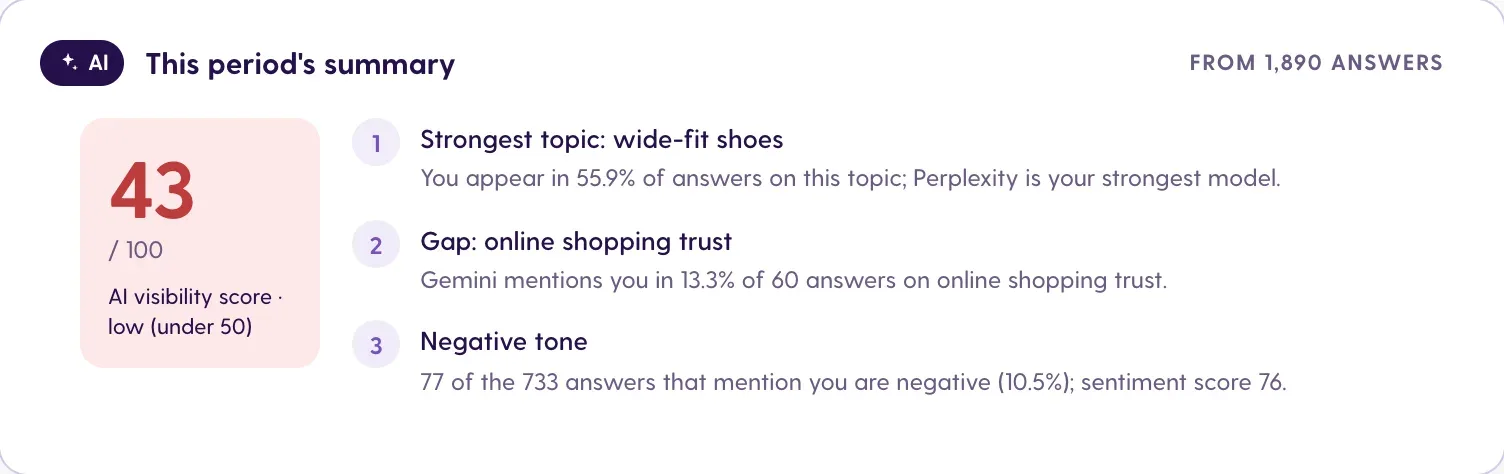
From there you can open any prompt to read the full answer per engine with brand order and sources, compare competitors with head-to-head and discovered brands, review insights such as first mentions, rising brands and where engines disagree, work through opportunity pages in Sources, and search across every stored answer. Reports export as PDF, CSV or XLSX, go out as weekly or monthly emails, or travel as password-protected, expiring share links. Cards can also be added as widgets to Meerkads custom dashboards, which is handy for agencies running client views.
Pricing: the tracker is not included in any Meerkads plan. The base subscription is $39.90 per month and includes 60 credits. One credit equals one prompt sent to one engine in one run. For example, 20 prompts on 3 engines checked weekly uses about 240 credits a month. Extra credits come in one-time packs that roll over: 50 credits for $32.90, 100 for $65.90, 250 for $162.90 and 500 for $325.90. See pricing for plan details.
If you also use the Keyword Tracker add-on, Meerkads lists pages that rank in Google's top 10 but are never cited in AI answers, which sites are cited instead, and how much search volume is at stake. For the organic side, see our guide to keyword tracking for ecommerce.
FAQ
What is AI visibility?
AI visibility describes how often and how prominently your brand appears in answers from AI assistants such as ChatGPT, Gemini, Perplexity and Google AI Overviews. It covers whether you are mentioned, in what position, with what sentiment, and whether your website is cited as a source.
How is LLM tracking different from rank tracking?
Rank tracking records the position of a URL on a search results page for a keyword. LLM tracking sends natural-language prompts to AI engines and analyzes the generated answer for brand mentions, order, sentiment and citations. Ranking well on Google does not guarantee being cited by AI, so the two complement each other.
How many prompts do I need?
Most brands get a reliable picture from a few prompts per topic across 10 to 15 topics, mixing recommendation, information, comparison and brand questions. Start smaller, check that the answers reflect real buyer questions, and expand once the routine is in place.
Why should I track with web search turned on?
With web search on, engines combine model knowledge with current web pages and show the sources they used, which matches what most users see. Without it, you measure older training data and get no citation information to act on.
How often should I check AI visibility?
Weekly works well for most competitive categories, and monthly is enough for stable markets. Because individual answers vary, judge progress on trends across several checks rather than a single result.
Hakan Sancak · CEO & Co-founderHakan Sancak is the CEO and co-founder of Meerkads. Writes about AI advertising, performance marketing and marketing analytics.