SEO
Ranking on Google but Invisible in AI Answers: A Practical GEO Playbook
Your pages rank on Google, yet ChatGPT, Gemini and Google AI Overviews cite someone else. Here is a step-by-step GEO playbook to measure that gap and work on it.
 Damla Teoman Avcıbaşı · 11 min read
Summarize with AI
Contents 7 sections
- Why ranking on Google does not guarantee a place in AI answers
- What AI engines tend to cite instead of you
- What generative engine optimization (GEO) means in practice
- The GEO playbook: six steps from gap to action
- How Meerkads produces the Ranks on Google, invisible to AI list
- Common mistakes to avoid
- FAQ
You did the SEO work. Your category page sits in Google's top 5, your buying guide ranks on page one, and Search Console shows steady clicks. Then you ask ChatGPT or Perplexity the same question your customers ask, and the answer recommends three competitors, quotes a forum thread and links to a magazine roundup. Your site is nowhere. This is the gap that generative engine optimization (GEO) tries to close: getting your brand mentioned, and your pages cited, in answers from ChatGPT, Gemini, Perplexity, Claude and Google AI Overviews.
A word of honesty before the playbook. GEO is young. The engines change how they retrieve and cite sources often, nobody outside them knows the exact rules, and no tool or agency can promise you a citation. What you can do is measure where you stand, understand who gets cited instead of you, improve what you control and check again. That loop is what this guide covers.
Why ranking on Google does not guarantee a place in AI answers
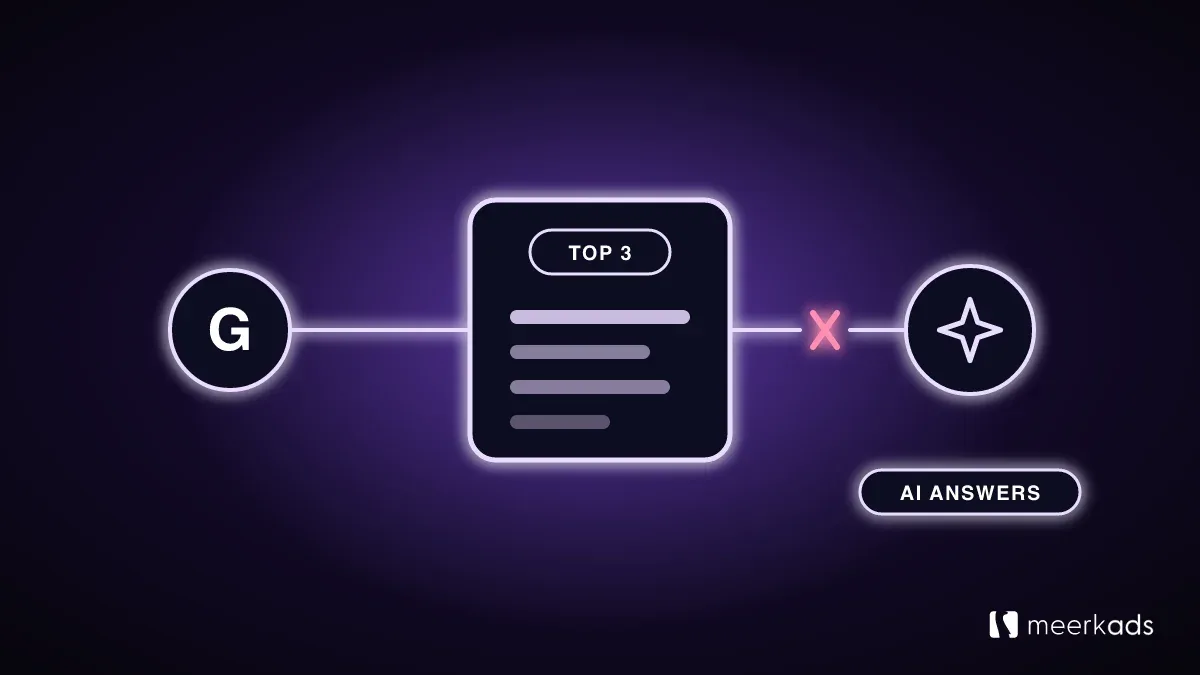
A classic search result is a ranked list of ten links. An AI answer is a short text built from a handful of sources, sometimes with links, sometimes without. Ranking fourth on Google makes you one of ten visible options. In an AI answer there may be room for three brands and two or three cited pages, and the selection works differently.
Prompts are not keywords
People type short phrases into Google. They ask an AI assistant something like: I have flat feet and run 30 km a week, which shoes should I look at under $150? Those longer, more specific questions pull in different pages. Google explains in its documentation on AI features that AI Overviews and AI Mode may use a query fan-out technique, running several related searches across subtopics to build a response. A page that ranks well for the head term may not be the best match for any of those sub-questions.
Each engine retrieves differently
ChatGPT, Perplexity, Gemini and Claude each run their own web search step and then decide which results to read and quote. Google AI Overviews rely on Google's own index, but even there the cited pages are not simply the top organic results in order.
AI engines like pages that settle a question
Answers are assembled from passages that state something clearly: a definition, a comparison, a price range, a pros and cons list, a recommendation for a specific situation. Many pages that rank well were written to rank: a long intro, a product grid, vague copy. They earn the click on Google but give a language model little to quote.
Third-party validation weighs heavily
When an AI engine recommends brands, it often leans on what others say about them: reviews, roundups, forum discussions, media coverage. If your brand is only described on your own site, an engine has less reason to name you, however well your pages rank.
What AI engines tend to cite instead of you
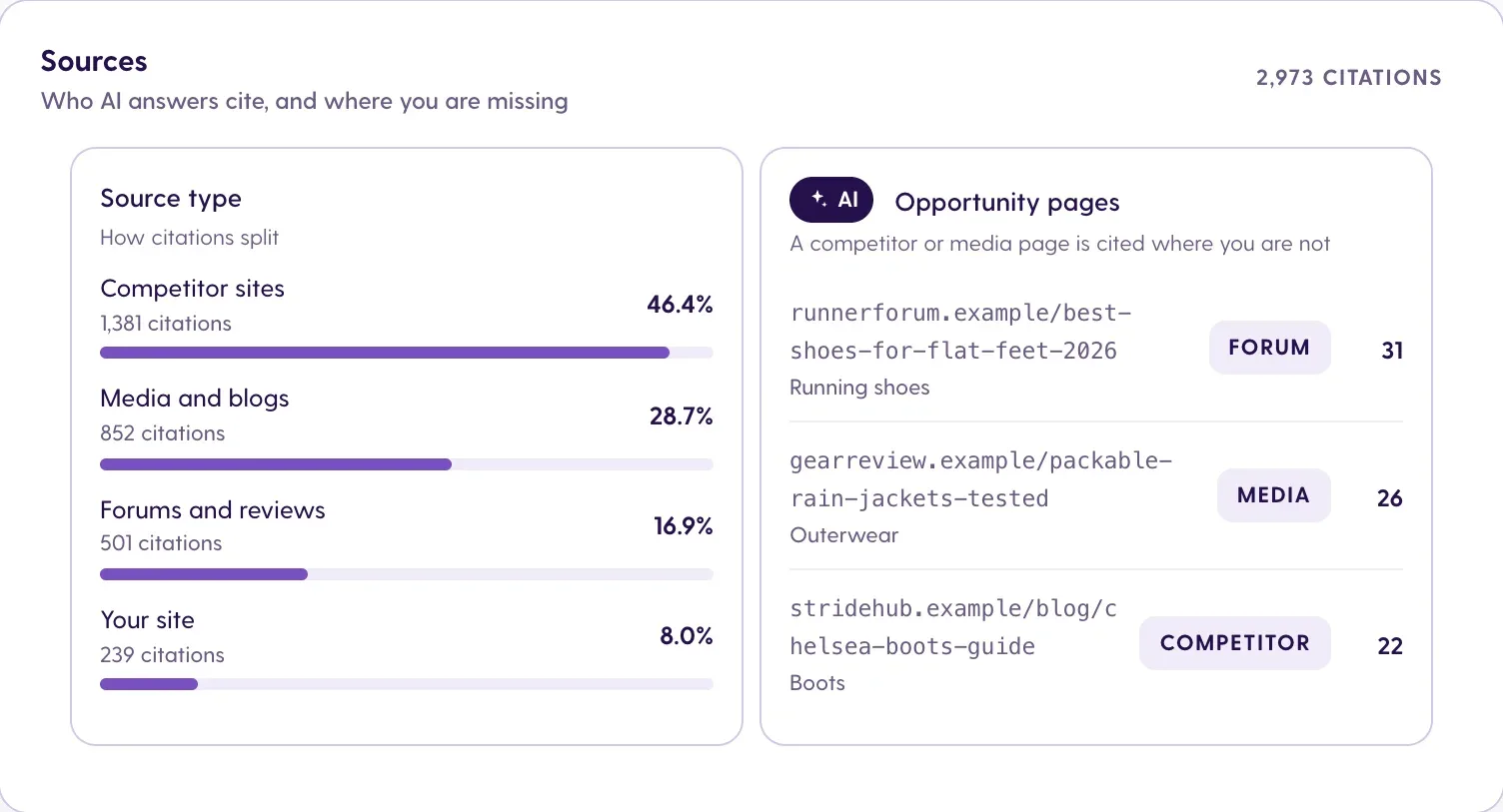
When you look at the sources behind AI answers in your category, a few patterns tend to come up. Treat them as hypotheses to check in your own data, not as universal rules. The mix varies by engine, country, language and industry.
- Forums and community threads: real users discussing problems and products in their own words.
- Media and editorial articles: buying guides, best-of lists and reviews from publishers.
- Comparison pages: X vs Y pages and alternatives pages, including those your competitors publish.
- Competitor pages: product pages, guides and pricing pages from brands you compete with.
- Marketplaces and stores: listings with specs, prices and reviews.
The useful question is not which sources AI likes in general. It is which sources AI cites for the questions your customers ask, and whether you are on any of them. That you can measure.
What generative engine optimization (GEO) means in practice
GEO is less a new discipline than a new lens on work you already know. Google states that there are no extra technical requirements to appear in AI Overviews or AI Mode and that the usual SEO best practices apply: crawlable pages, helpful content, a good page experience.
What changes is the scoreboard. Instead of asking where you rank for a keyword, you track your AI search visibility with three questions:
- Am I mentioned when someone asks a non-branded question in my category?
- Is my site cited as a source in that answer?
- Who takes my place when I am not there?
Generative engine optimization means answering those questions regularly and acting on what you find. Because the engines keep changing, it works as a loop, not a one-off project.
The GEO playbook: six steps from gap to action
Step 1: Measure the gap between Google and AI
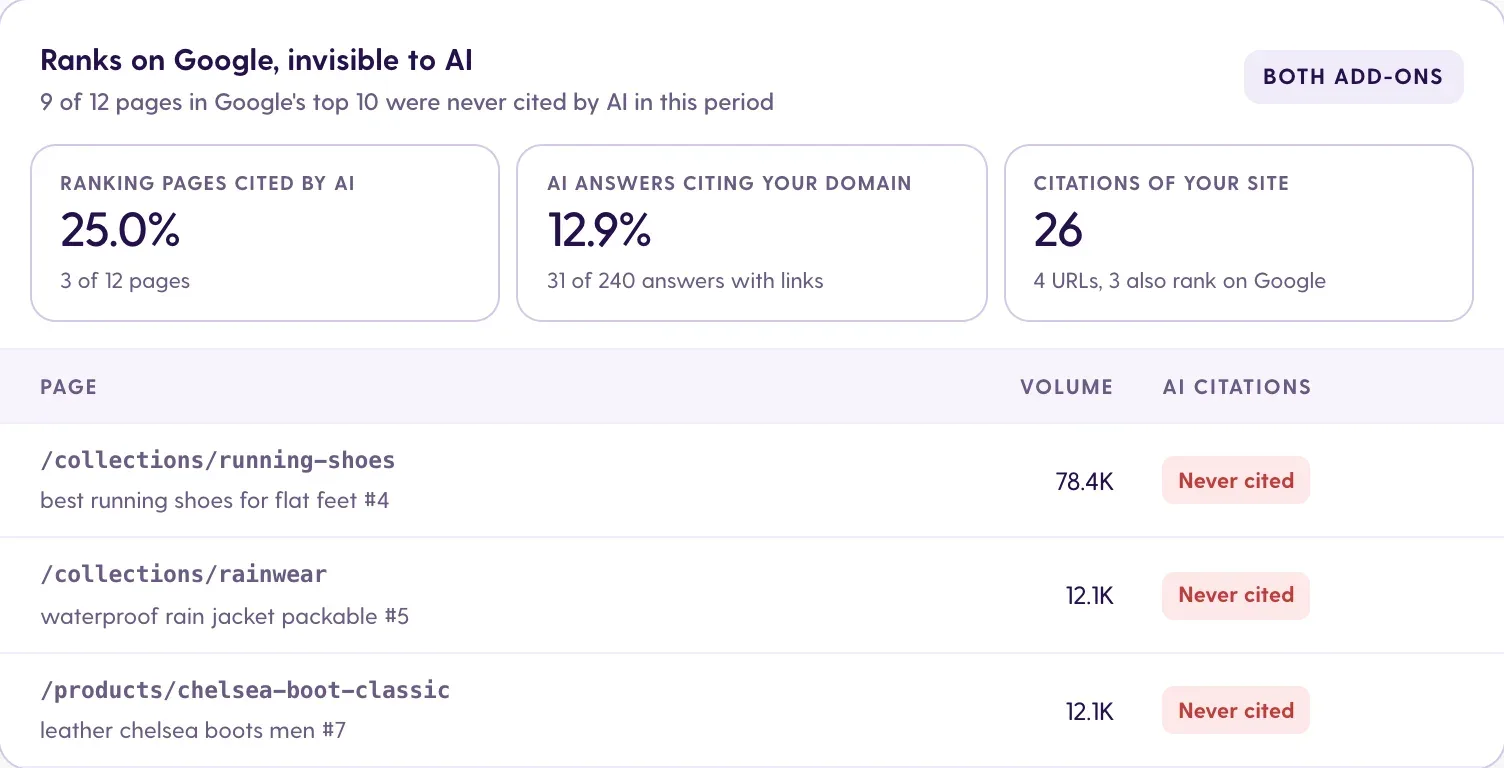
Start with the pages you already win on Google. For each keyword where you rank in the top 10, you want to know whether that page is ever cited in AI answers on related questions, which sites are cited instead, and how much monthly search volume sits behind it.
Prioritize by volume. A page that ranks third for a high-volume keyword and never appears in AI answers is a bigger gap than an eighth place on a niche term. If you need a refresher on reading rankings, our guide to keyword tracking for ecommerce covers the basics.
| Data point | What it tells you |
|---|---|
| Keyword and ranking URL | Which of your pages wins on Google, and for what |
| Google position | How strong your organic signal already is |
| Cited in AI answers | Whether any engine uses that page as a source |
| Sites cited instead | Who takes the citation you are missing |
| Monthly search volume | How much demand sits behind the gap |
Step 2: Check AI Overviews on your own keywords
Google AI Overviews are the AI answers closest to your existing SEO work, because they appear on the same results page as your rankings. For every tracked keyword, record whether an AI Overview shows, whether your site is among its sources, and which domains are cited instead.
This tells you two things. Where AI Overviews appear on important keywords, your position alone can overstate how visible you really are. And the sources an AI Overview cites are a short list of exactly the pages worth studying.
Compare this with Search Console. If a keyword holds its position but clicks and CTR fall, an AI Overview on that query is one possible explanation worth checking.
Step 3: Find the opportunity sources
Next, look at the pages AI engines cite for your non-branded prompts where a competitor or a media outlet appears but you do not. These are your opportunity sources. Group them by type:
- Competitor pages: study what they say that you do not. Often it is a clear comparison, a direct answer or specific numbers.
- Media and editorial pages: roundups and guides where your brand could reasonably be included.
- Forums and communities: discussions where your product is relevant and a genuine, helpful answer is welcome.
- Marketplaces and stores: listings where your product data, reviews or availability may be incomplete.
Read the actual answers, not only the domain lists: they show which criteria the engine uses to recommend brands.
Step 4: Improve the pages you control
For the pages on your gap list, make them easier to quote. A few practical changes:
- Answer first. Put a clear two or three sentence answer to the main question near the top, before the long explanation.
- Add comparisons. If customers compare options, give them a fair comparison: criteria, who each option suits, honest trade-offs.
- Use concrete facts. Prices, dimensions, compatibility, delivery times, materials, guarantees. Specific, verifiable statements are easier to cite than adjectives.
- Structure the page. Descriptive headings, short paragraphs, and lists or tables where the content really is a list or a table.
- Cover the follow-up questions. Look at the prompts where you are missing and answer the sub-questions inside them: use cases, budgets, edge cases.
- Keep it current and readable. Update facts and dates, keep the page indexable and make sure key information is in the HTML text, not only in images.
None of this is a trick. It is the people-first content Google describes in its guidance on creating helpful, reliable content, written with the awareness that a model may read only one passage of your page.
Step 5: Earn mentions where AI looks
Your own pages are only half of the picture. If AI engines in your category rely on media roundups, forums and comparison pages, you need to be present there, honestly.
- Pitch your product to the publications that keep showing up in your sources, with facts and samples rather than slogans.
- Make it easy for reviewers and comparison sites to get accurate information: specs, pricing, images, a contact person.
- Take part in relevant community discussions as a recognizable brand, answering questions instead of dropping links.
- Keep marketplace listings complete and consistent with your site.
This is slow work and results are not guaranteed. Prioritize sources that appear across several engines and several prompts, since those are the most likely to matter.
Step 6: Re-measure with non-branded prompts
After you change pages or earn new mentions, measure again with the same set of prompts. Use non-branded prompts as your main yardstick. A question like which is the best running shoe for flat feet tells you whether AI engines recommend you on their own. A question that names your brand mostly tells you how you are described once someone already knows you.
Give changes time. Engines need to recrawl your pages and answers vary from run to run, so look at trends across several checks and several engines instead of reacting to a single answer. Our guide on tracking AI visibility goes deeper into prompts and metrics.
How Meerkads produces the Ranks on Google, invisible to AI list
Doing this by hand means exporting rankings and running dozens of prompts every week. In Meerkads, two paid add-ons collect the data for you and meet in one list.
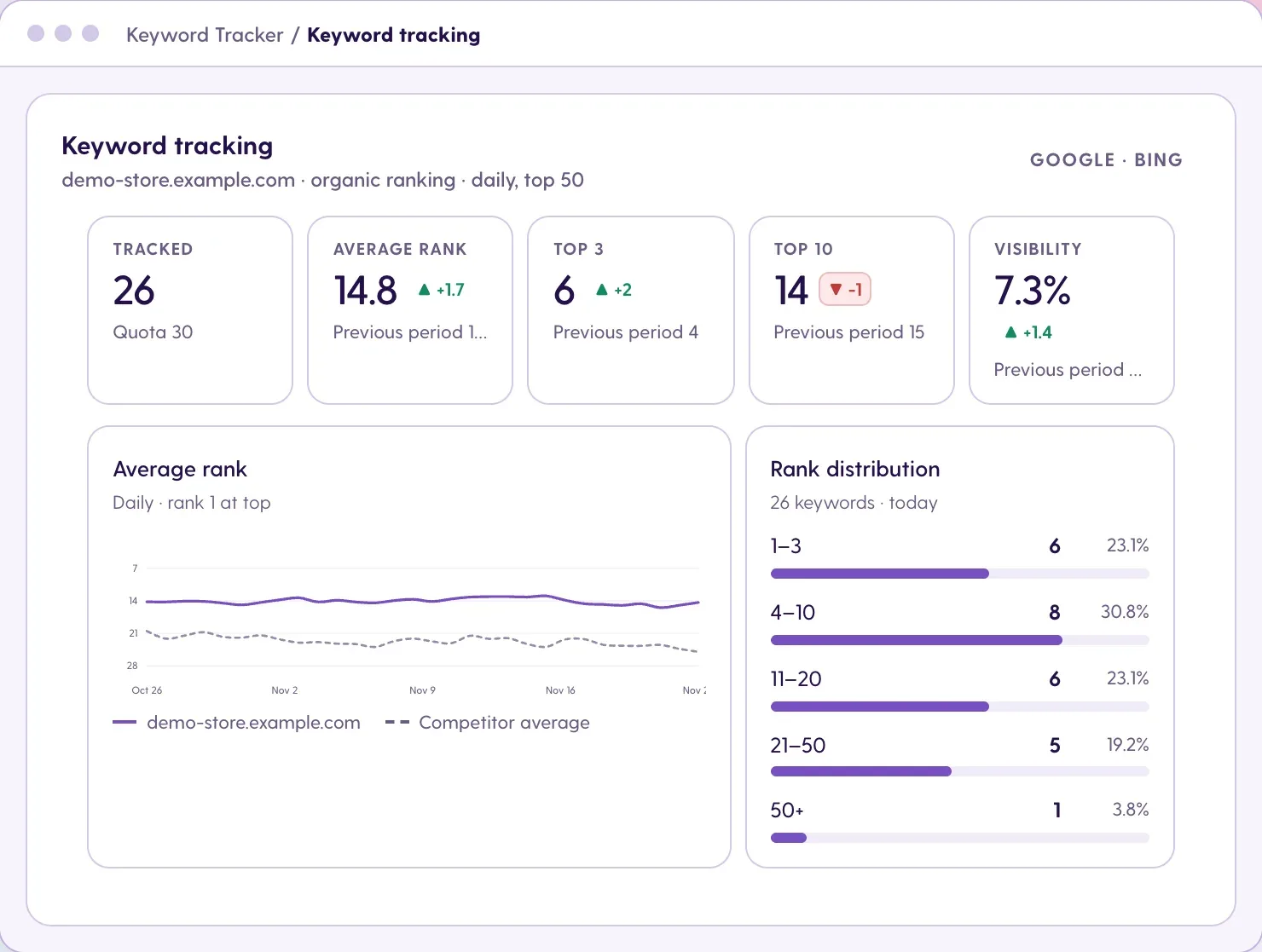
The Keyword Tracker checks your organic positions every day on Google or Bing for the keywords you choose, along with up to 5 competitor domains. It stores the top 50 results, your ranking URL and monthly search volume, and for Google it records whether an AI Overview shows and which sources it cites.
The AI Visibility (LLM) Tracker sends your prompts to ChatGPT, Gemini, Perplexity, Claude, Google AI Overviews and Google AI Mode with web search on and your country as the location. It records whether your brand appears, at which position, how it is described and which sources are cited. It also verifies in the answer text that a brand really appears, so brands the AI invented are filtered out. Cited domains are classified as your site, competitor, marketplace, forum, store or media.
With both add-ons active, Meerkads lists the pages that rank in Google's top 10 but are never cited in AI answers, the sites cited instead and the search volume that represents. That list is Step 1, ready made, and the Sources view gives you the opportunity pages for Step 3.
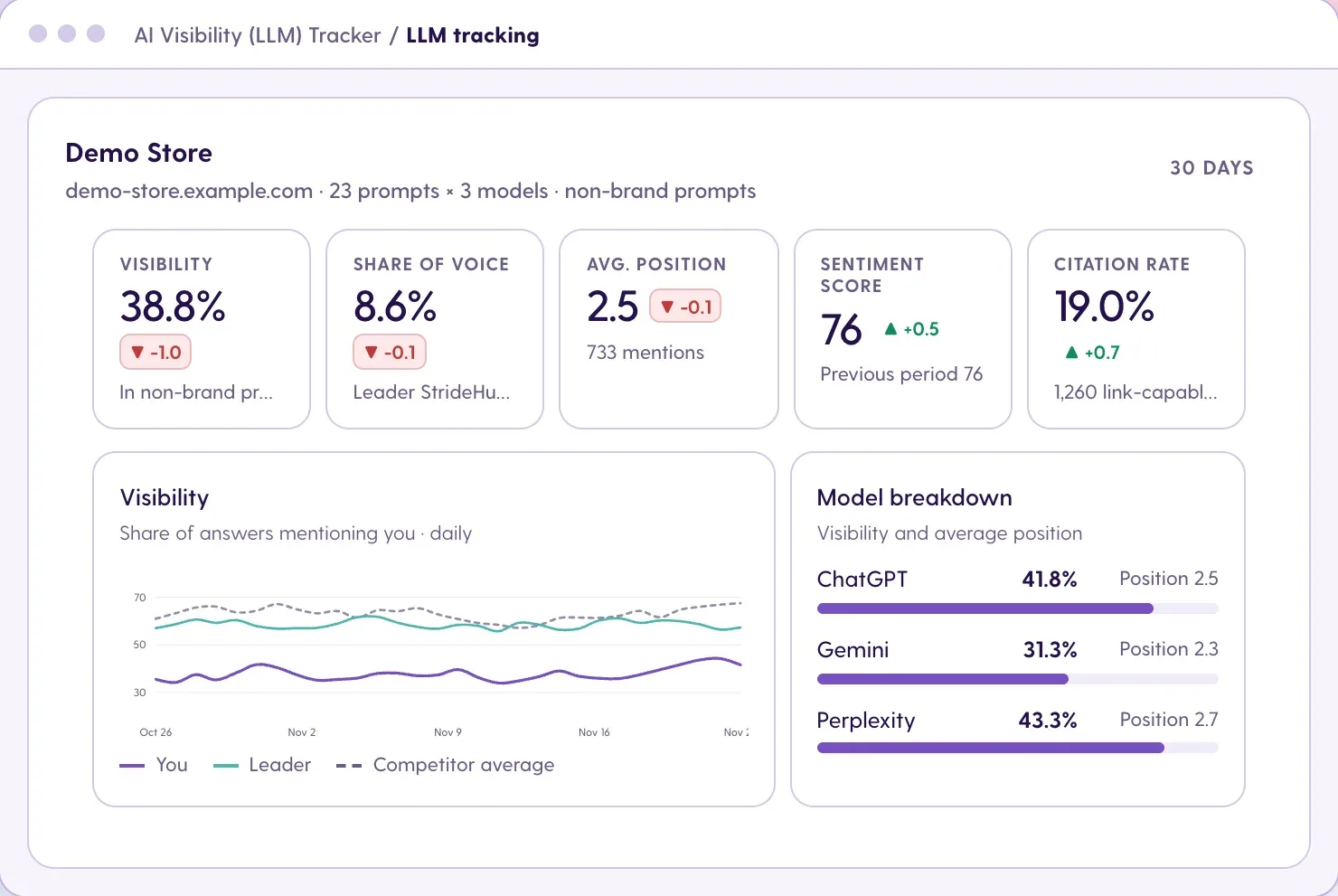
Setup is quick. The Keyword Tracker takes about two minutes: your domain comes from your connected Search Console property, and keyword suggestions can come from Search Console too. The AI Visibility Tracker guides you through five steps (brand, topics, competitors, prompts, summary) with AI suggestions, and first results arrive in about 25 minutes. Its metrics are split into branded and non-branded prompts, with non-branded as the default for a fair competitor comparison.
On cost: the Sentinel plan includes 20 tracked keywords, and monthly packs add 100, 250 or 500 more. The AI Visibility Tracker is a separate subscription at $39.90 per month with 60 credits, plus optional credit packs that roll over. All details are on the pricing page.
Each workspace tracks one domain and one brand, which keeps data clean when you manage several clients as an agency. For ecommerce brands, category pages and buying guides are a good place to start, since that is where shopping questions to AI tend to land.
Common mistakes to avoid
- Judging from one prompt. A single answer in a single engine says little. Look at many prompts across engines and over time.
- Measuring only branded prompts. They flatter you. Non-branded prompts show whether you win new customers.
- Breaking what works on Google. Rewrites should add clarity, not remove the content that earns your ranking.
- Chasing every cited domain. Focus on sources that recur across engines and prompts.
- Treating GEO as a replacement for SEO. Strong organic pages remain the base most engines read from.
FAQ
What is generative engine optimization (GEO)?
GEO is the practice of improving how often your brand is mentioned and your pages are cited in answers from AI engines such as ChatGPT, Gemini, Perplexity, Claude and Google AI Overviews. It builds on SEO fundamentals but measures mentions, citations and position within AI answers, not only rankings.
Why does my page rank on Google but never appear in ChatGPT or Perplexity answers?
AI engines run their own searches, often for longer and more specific questions, and quote only a few sources. They tend to favor pages that answer clearly and sources with third-party validation, such as media, forums and comparison pages. A good Google ranking helps but does not guarantee selection.
Do I need special markup to appear in Google AI Overviews?
Google's documentation says there are no additional technical requirements beyond being indexed and eligible to show a snippet in Search. The usual SEO best practices apply. Focus on helpful, well-structured content with key information available as text.
How long does GEO take to show results?
There is no reliable timeline. Engines need to recrawl updated pages, and mentions on third-party sites take time to earn and to be picked up. Measure regularly and judge trends over several weeks and several engines rather than one check.
Which GEO or AI SEO tools do I need to start?
You need two data sets: organic rankings with AI Overview sources, and AI answers with mentions and citations for non-branded prompts. In Meerkads, the Keyword Tracker and AI Visibility (LLM) Tracker add-ons cover both and combine them into the Ranks on Google, invisible to AI list.
Damla Teoman Avcıbaşı · Sales & Marketing LeadDamla Teoman Avcıbaşı is the Sales & Marketing Lead at Meerkads. Writes about AI in marketing, marketing tools and growth.