PPC
AI Tools for Marketing: What to Use for Content, Ads, SEO, Ecommerce and Reporting
There is an AI tool for every marketing task. Here is what to use for research, content, creative, SEO, ads, ecommerce, email, reporting and sales, what to keep human, and example stacks for every team size.
 Damla Teoman Avcıbaşı · 13 min read
Summarize with AI
Contents 14 sections
- Where AI in marketing stands today
- AI tools for research and strategy
- AI tools for content and copywriting
- AI tools for images and video
- AI tools for SEO and AI search visibility
- AI tools for ads and performance analytics
- AI tools for ecommerce
- AI tools for email, CRM and automation
- AI tools for reporting and dashboards
- AI tools for sales enablement
- Example AI marketing stacks by team size
- How to choose AI tools for marketing
- Common mistakes to avoid
- Frequently asked questions
Ask ten marketers which AI tools they use and you will get ten different lists. That is the real challenge now. Finding an AI tool is easy; there is one for every task, and new ones launch every week. Choosing the few that actually save your team time, and making them work together, is the hard part.
This guide sorts AI tools for marketing by what you need to get done: research, content, creative, SEO, ads, ecommerce, email and CRM, reporting and sales. For each area you will find what AI does well today, a few established tools worth knowing, and what should stay in human hands. At the end there are example stacks for different team sizes and a checklist for choosing tools.
Where AI in marketing stands today
AI is no longer an experiment in most marketing teams. The question has moved from "should we use it" to "how do we get value from it".
- Almost every team uses it. In HubSpot's 2026 State of Marketing report, based on more than 1,500 B2B and B2C marketers, 86.4% of marketing teams say they use AI in at least a few areas, and only 1.7% neither use it nor plan to.
- Marketing is where the revenue shows up. McKinsey's State of AI 2026 found that nearly nine in ten organisations use AI regularly, and that revenue gains are most often attributed to AI in marketing and sales.
- Budgets are following. Gartner's 2026 CMO Spend Survey found that CMOs allocate an average of 15.3% of marketing budgets to AI initiatives.
- But few teams are getting the full benefit. In the same Gartner survey, only 30% of CMOs report mature AI readiness. Salesforce's State of Marketing report found that 75% of marketing organisations use AI in some form, but only 13% use self-directed agents.
The gap between using AI and benefiting from it usually comes down to tool choice and how well the tools fit into the work. That is what the rest of this guide is about.
AI tools for research and strategy
Research used to mean hours of searching, reading and summarising. "Deep research" features in general-purpose assistants now do the first pass for you: they run many searches, read the sources and return a report with citations.
- ChatGPT deep research is an agentic capability that conducts multi-step research on the internet for complex tasks.
- Claude Research runs searches that build on each other and returns answers with easy-to-check citations.
- Perplexity Deep Research performs dozens of searches and reads hundreds of sources to produce a report.
- Gemini Deep Research can browse up to hundreds of websites and create multi-page reports in minutes.
Good for: competitor and market overviews, audience research, first drafts of positioning and campaign briefs. Keep human: checking the sources. OpenAI itself notes that deep research can sometimes hallucinate facts or make incorrect inferences. Treat every report as a well-organised starting point, not a finished answer.
AI tools for content and copywriting
Content creation is the most common use of AI in marketing. HubSpot found that 42.5% of marketers use AI extensively for content creation and another 38% use it occasionally. The difference between generic output and useful output is context: your brand voice, your products and your audience.
- Jasper focuses on brand consistency. Its Jasper IQ turns your brand, products and audiences into context that governs every output.
- HubSpot Breeze Content Agent builds blog posts, social content and landing pages in your brand voice, inside the CRM your team may already use.
- Notion AI lets teams generate drafts and improve writing directly in their pages and set up custom agents for recurring work.
- Grammarly has grown from a spelling checker into an AI document editor that supports the whole writing process.
Good for: first drafts, variations for testing, repurposing one piece into many formats, editing. Keep human: the point of view. Gartner found that 50% of US consumers would prefer to give their business to brands that do not use GenAI in consumer-facing content. Use AI to go faster, and make sure the final piece still sounds like you and says something only you can say.
AI tools for images and video
Creative used to be the bottleneck for testing. Generative tools now produce image and video variations in minutes, and the ad platforms build them directly into campaign setup.
- Adobe Firefly is positioned for commercial use. Adobe says it developed the Firefly models to be commercially safe and has never trained them on customer content.
- Canva Magic Studio includes Magic Switch, which scales one design into multi-channel campaigns by resizing and adapting it for each format.
- Google Flow is an AI filmmaking tool built for Google's Veo, Imagen and Gemini models.
- Runway Gen-4 can generate consistent characters, locations and objects across scenes, which matters for anything longer than a single shot.
- Ad platforms' own tools. TikTok's Symphony Creative Studio generates TikTok-optimised videos, and Meta's Advantage+ creative uses AI to generate and enhance ad variations across image, video and carousel formats.
Good for: variations for A/B tests, resizing for every placement, product shots, storyboards and concept videos. Keep human: the creative idea and brand safety. More variations only help if you can tell which ones work, so pair creative tools with a way to spot creative fatigue early.
AI tools for SEO and AI search visibility
Search is changing shape. Google says AI Overviews has over 2 billion monthly users, and in July 2026 it reported that AI Mode had passed 1 billion monthly active users. Customers also ask ChatGPT, Claude, Perplexity and Gemini for product recommendations. Ranking on page one is no longer the only question; you also need to know whether AI answers mention your brand.
- Google Search Console remains the baseline. Google says there are no special optimisations needed to appear in AI Overviews or AI Mode, and that traffic from these features is included in Search Console reports.
- Ahrefs Brand Radar tracks your brand's visibility across AI answers, including AI Overviews, AI Mode, ChatGPT, Perplexity, Gemini and Copilot.
- Semrush AI Visibility Toolkit offers prompt tracking for specific, high-value prompts on platforms like Google AI Mode and ChatGPT.
- Meerkads add-ons. Meerkads includes an LLM visibility tracker that shows how AI assistants mention your brand, and keyword tracking, next to your ad and store data. If you already use Meerkads for ads, you can see paid and organic visibility in one place.
Good for: keyword and topic research, content briefs, technical audits, tracking brand mentions in AI answers. Keep human: deciding what your brand should be known for. AI search rewards clear, expert, well-structured content; tools can measure it, but someone has to write it.
AI tools for ads and performance analytics
Every major ad platform now runs on AI. The tools are powerful, but each one optimises inside its own walls.
- Google Ads AI Max for Search adds improved search term matching, better text customisation and final URL expansion to Search campaigns.
- Google Ads Advisor is an AI partner that helps you manage campaigns directly within Google Ads, with an Analytics Advisor counterpart for GA4.
- Meta Advantage+ applies AI across your campaign's audience, placement and budget.
- GA4 predictive metrics estimate purchase probability, churn probability and predicted revenue. They need enough data to work: Google requires at least 1,000 returning users who triggered the relevant condition.
The missing piece is a neutral view across platforms. Google's AI grades Google, Meta's AI grades Meta, and both can claim the same sale. A cross-channel layer like Meerkads AI recommendations compares every channel on the same metrics and against actual store revenue, then explains what changed and what to do next. We cover this area in depth in our complete guide to managing ads with AI.
Keep human: budget strategy, approving changes and deciding which numbers matter to the business.
AI tools for ecommerce
Ecommerce teams have some of the most practical AI use cases, because so much of the work is repetitive: hundreds of product descriptions, thousands of images, feeds that must stay accurate.
- Shopify Sidekick is Shopify's built-in assistant. It works with your store's data and presents changes for your review before applying them. Shopify's AI text features, previously branded Shopify Magic, write product descriptions, blog posts and emails, many at no additional cost.
- Google Merchant Center Product Studio helps you optimise product images using AI directly in Merchant Center.
- Amazon's generative AI listing tools let sellers create listings by describing a product in a few words, uploading an image or providing a URL.
- Klaviyo uses predictive AI for insights like customer lifetime value and channel preference, which helps segment and personalise campaigns.
- Meerkads for ecommerce. Meerkads connects ad spend to actual store revenue, shows product-level performance across channels, and includes add-ons for product feed and catalog image optimisation, so the products you advertise are presented at their best on every platform.
Good for: product content at scale, image cleanup and backgrounds, feed quality, segmentation, first-line customer service. Keep human: pricing, merchandising and promotions. Also check product facts: an AI-written description that invents a material or a size creates returns, not sales. For why ad platforms and your store rarely agree, see why your Meta Ads dashboard and Shopify revenue never match.
AI tools for email, CRM and automation
CRM and email platforms are moving from "AI writes the subject line" to agents that plan and run campaigns within limits you set.
- Klaviyo Composer takes a goal: tell it what you are trying to achieve, and it builds the audience and the campaign.
- HubSpot Breeze agents include a Customer Agent that resolves inquiries automatically across channels.
- Salesforce Agentforce Marketing lets marketers define goals, budgets, guardrails and autonomy limits for marketing agents. Some of these agents were still in pilot as of June 2026.
- Zapier Agents connect the rest of your stack and can perform tasks across 9,000+ apps.
Good for: segmentation, send-time and channel choices, lifecycle flows, routine customer questions, moving data between tools. Keep human: the guardrails. Decide what an agent may do alone, what needs approval, and who checks the results.
AI tools for reporting and dashboards
Reporting is where many teams still lose the most time. Pulling numbers from every platform into one view, every week, is exactly the kind of work AI should take over.
- Data Studio (formerly Looker Studio) is the free default for many teams. Google is adding Conversational Analytics, a chat-with-your-data feature powered by Gemini, which is in preview. Note that Google Ads and Analytics data sources refresh every 12 hours, and that rate can't be changed.
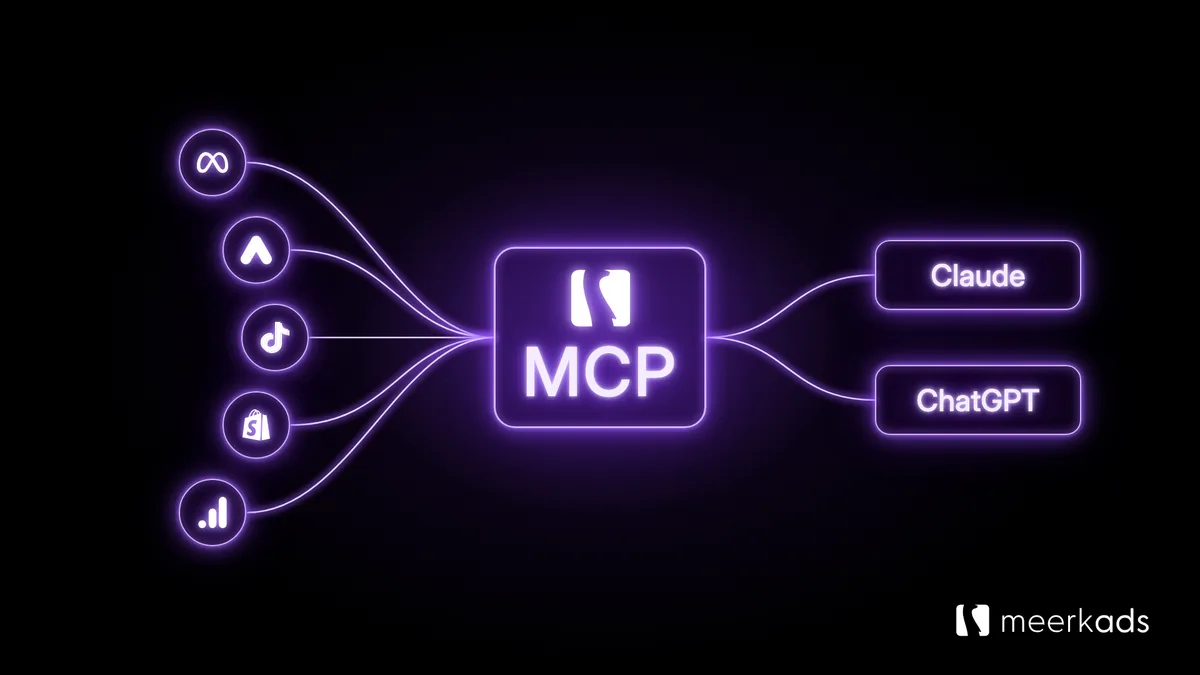
- AI assistants connected to your data. Through the Model Context Protocol, Claude and ChatGPT can read your ad data directly and answer questions in plain language. Our comparison of ad platform MCP servers explains the options, and you can connect Meerkads to Claude or ChatGPT.
- Meerkads connects all your ad channels, your store and analytics into live dashboards and scheduled reports, with alerts when something breaks. Agencies get white-label client reports.
Good for: building reports, writing summaries, spotting anomalies, answering ad hoc questions. Keep human: choosing the metrics and telling the story. We wrote more about this in what AI can and can't do for marketing reporting.
AI tools for sales enablement
Marketing and sales share the same funnel, and AI is closing the gap between them. Marketing generates the lead; sales tools now help qualify it, follow up and learn from every conversation.
- Gong offers purpose-built agents for pipeline review, coaching and deal risk, based on recorded sales conversations.
- HubSpot Breeze Prospecting Agent can monitor buying signals and launch personalised outreach automatically.
- Salesforce Agentforce includes an AI sales agent that answers lead questions and handles objections grounded in your business data, and a prospecting agent that Salesforce made generally available in June 2026.
Good for: call notes and summaries, lead research, follow-up drafts, spotting deals at risk. Keep human: relationships. Buyers can tell when nobody has actually read their message. The best use of AI here is giving salespeople more time for real conversations, not replacing them. Feed what sales learns back to marketing: the objections you hear on calls are the best brief for your next campaign.
Example AI marketing stacks by team size
You don't need a tool from every category. Start with the work that costs you the most time, and add tools only when they replace a real task.
Solo marketer or founder
- One general assistant (ChatGPT, Claude or Gemini) for research, writing and analysis.
- Canva for design, plus the ad platforms' own creative tools.
- Your store's built-in AI, such as Shopify Sidekick, for product content.
- One place that shows all your ad and store numbers together, so you are not checking five dashboards.
Growing brand with a small team
- A shared assistant workspace on a business plan, so company data is not used for training.
- A content tool that keeps brand voice consistent.
- An email or CRM platform with predictive segmentation.
- Cross-channel analytics with alerts and AI recommendations, matched to actual store revenue.
- AI search visibility tracking alongside classic SEO.
Agency
- Multi-client analytics with white-label dashboards and reports.
- Automated monitoring, so problems in any client account are caught the same day.
- Assistants connected to client data through MCP for fast answers.
- Clear rules on which client data may go into which AI tool.
How to choose AI tools for marketing
Use these questions before you add another subscription.
- Which task does it replace? If you can't name the hours it saves each week, it is a nice-to-have.
- Does it use your data? Generic output is everywhere. Tools grounded in your brand, products and performance data produce work that is actually yours.
- Does it connect to the rest of your stack? A tool that lives on its own island creates one more export and one more copy-paste.
- Is your data safe? Check whether your inputs are used for training. OpenAI says that by default it does not use business data for training on its business plans and API, and Anthropic says it will not use inputs or outputs from its commercial products to train models by default. Consumer plans can differ.
- Does it keep up? AI changes every few months. Prefer vendors that bring new models and capabilities into the product, so you benefit without switching tools.
- What does the whole stack cost? Add up seats, connectors and add-ons. One platform that replaces three tools is often cheaper than it looks.
Common mistakes to avoid
- Collecting tools instead of solving problems. Ten trials and no workflow is the most common outcome. Pick one process, automate it end to end, then move to the next.
- Publishing without checking. AI can state wrong facts confidently. Have a person check numbers, claims and product details before anything goes live.
- Losing your brand voice. If every brand uses the same assistant with the same prompts, everything starts to sound the same. Give tools your guidelines and examples, and edit with a strong hand.
- Ignoring disclosure rules. Under the EU AI Act, transparency rules take effect in August 2026, and providers of generative AI must ensure that AI-generated content is identifiable. If you sell in Europe, check how this applies to your content, especially realistic images and video.
- Not measuring the result. Track time saved and performance before and after. Without numbers, you can't tell which tools are worth keeping.
Frequently asked questions
What is the best AI tool for marketing?
There is no single best tool; it depends on the task. For most teams, a general assistant (ChatGPT, Claude or Gemini) covers research and writing, and specialised tools add the most value where your data lives: ads, store, CRM and reporting.
Are there free AI tools for marketing?
Yes. Many tools you already use include AI: Shopify's AI text features are largely available at no additional cost, ad platforms build creative tools into campaign setup, and general assistants have free tiers. Free tools are a good start, but check how they handle your data.
Will AI replace marketers?
AI is replacing tasks, not the job. Drafting, resizing, reporting and first-pass analysis are increasingly automated. Strategy, positioning, creative judgement and accountability stay human, and marketers who use AI well will have an advantage over those who don't.
How do I start using AI in my marketing team?
Pick the task that costs your team the most time each week, often reporting or content production, and automate that first. Set simple rules for data and review, measure the time saved, then expand.
Is it safe to use AI tools with customer data?
Use business plans that don't train on your data, keep personal customer data out of tools that don't need it, and prefer read-only access for analysis. Our privacy policy explains exactly what Meerkads shares with AI assistants.
Want to see how AI turns your ad and store data into clear answers? Book a 20-minute demo or start your free trial.
Damla Teoman Avcıbaşı · Sales & Marketing LeadDamla Teoman Avcıbaşı is the Sales & Marketing Lead at Meerkads. Writes about AI in marketing, marketing tools and growth.