
PPC
ChatGPT Ads: What Performance Marketers Need to Know Before Testing
ChatGPT has officially expanded into an advertising platform. Following initial US testing in February 2026, OpenAI rolled out ads across more than 60 countries by late September.
 Meerkads Team · 9 min read

Summarize with AI
Contents 7 sections
ChatGPT has officially expanded into an advertising platform. Following initial US testing in February 2026, OpenAI rolled out ads across more than 60 countries by late September. This shift introduces core operational questions for performance marketers: audience reach, targeting mechanics in a keyword-free environment, cost per click, and ROI measurement validity.
What Are ChatGPT Ads?
ChatGPT Ads are paid ad placements displayed within ChatGPT conversations. Positioned right beneath ChatGPT's response as a clearly tagged card, each ad features the brand's name, logo, headline, main copy, visual image, and destination link. Advertisers can purchase and manage these placements through OpenAI's native platform, Ads Manager (ads.openai.com).
Who Sees ChatGPT Ads?
Ads are shown only to logged-in adults on the Free and Go plans. Go is OpenAI's low-cost plan at $8 per month in the US. Together, these two plans make up most of ChatGPT's roughly 1 billion weekly users.
Users on Plus, Pro, Business, Enterprise, and Education plans never see ads. OpenAI also skips accounts it knows or predicts belong to someone under 18. Ads are not eligible to appear near sensitive or regulated topics such as health, mental health, and politics. Free users who don't want ads can also choose an ad-free option with lower daily message limits.
Do Ads Influence ChatGPT's Answers?
OpenAI says no. Its ad principles state that ads are always separate and clearly labeled, that they do not change the answer, and that conversations are not shared with advertisers. Advertisers only receive aggregated performance data.
For marketers, this has one clear consequence: paying for ads does not make ChatGPT recommend your brand inside its answer. Organic visibility in AI answers and sponsored placements are two separate channels.
Where Are ChatGPT Ads Available?
The rollout moved quickly. After the US pilot, OpenAI added the UK, Europe, Asian markets, India, the Middle East, and North Africa. On August 31, 2026, OpenAI said the business had reached a $1 billion annualized revenue run rate in under 200 days and was used by tens of thousands of advertisers.
How Do ChatGPT Ads Work?
ChatGPT Ads match ads to the conversation, not to keywords. When a user asks a question, the system looks at the context and intent of that conversation, then picks a relevant ad from available inventory.
What Signals Decide Which Ad Appears?
According to OpenAI's Help Center, ad selection considers the current conversation, your landing page, ad title, ad copy, and the context hints you provide. If the user has ad personalization turned on, selected signals from their wider ChatGPT activity can also be used. Users can turn personalization off, see why an ad was shown, and clear their ad history.
What Are Context Hints?
Context hints are the main targeting lever in ChatGPT Ads. They are short descriptions of the conversations, topics, and needs where your ad should appear. Each ad group accepts up to 2,000 hints.
They are not exact-match keywords, and they don't guarantee that your ad will appear in any specific conversation.
Why Google Ads Habits Don't Transfer
There are no keywords, demographic targeting, dayparting, or frequency caps, and reporting doesn't show which prompts triggered your ad. Targeting options are limited to context hints, location targeting with exclusions, and custom audiences, which need at least 25,000 matched records. Because of this, a Google Ads keyword strategy doesn't carry over directly.
What Ad Formats Are Available?
The original format was a single sponsored card below the answer. Since then, OpenAI has added product feed campaigns for ecommerce, uploaded via CSV, hosted URL, or SFTP, and a carousel format that shows several products in one unit. Video ads are not available yet.
How Much Do ChatGPT Ads Cost?
ChatGPT Ads run on an auction, so there is no fixed price per click. What has changed since launch is the entry barrier: the large minimum commitment from the pilot no longer applies.
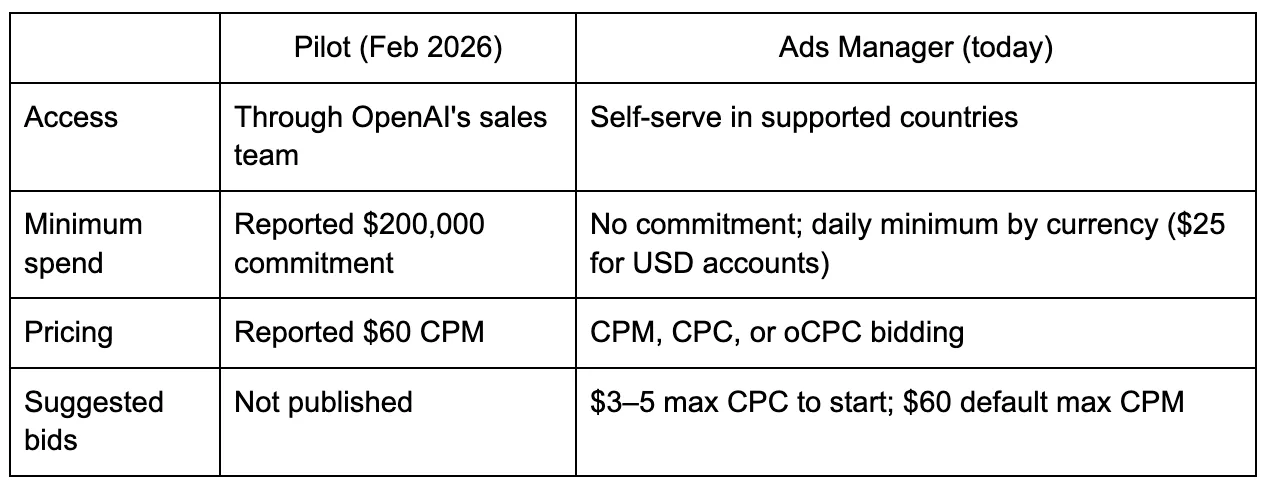
$3–5 max CPC to start; $60 default max CPM
Advertisers set a maximum bid at the ad-group level. Daily budgets work as a seven-day average: spend can reach up to twice the daily budget on a single day, but never more than seven times it over a week.
What Do Advertisers Actually Pay?
Advertisers sharing results on Reddit's r/PPC report CPCs of roughly $2 to $8, with most between $3 and $5. These are individual reports, not official averages. OpenAI has not published CPC or CPM benchmarks.
How Do You Advertise on ChatGPT?
You create campaigns in OpenAI's Ads Manager Beta. The structure will feel familiar if you have used Google or Meta: campaign, ad group, and ad.
- Check eligibility. Your business must be registered in a country where Ads Manager is available.
- Choose an objective. Pick CPM, CPC, or oCPC (clicks optimized for conversions). The objective can't be changed after the campaign is created.
- Set budget and bid. Choose a daily or campaign-total budget, then a maximum bid per ad group.
- Write context hints. Describe the conversations where your ad belongs, in plain language.
- Add creativity. Title, description, image, and landing page.
- Install measurement before launch. Set up the OpenAI Pixel or Conversions API and add UTM parameters.
The countries a campaign targets don't have to match the country where the account is registered.
What Can't You Advertise on ChatGPT?
OpenAI's ad policies block a long list of categories, including dating and sexual content, health claims, alcohol and drugs, gambling, and political content. Financial services, healthcare, and legal services are allowed only for approved advertisers, case by case, and currently only in the US. Outside the US, health and finance ads are generally not accepted, and legal services ads are not allowed at all. The policy has been updated several times since March 2026, so check the latest version before planning a campaign.
How Do You Measure ChatGPT Ads?
Use two layers: OpenAI's own tracking for in-platform optimization, and GA4 for comparing ChatGPT with every other channel.
OpenAI Pixel and Conversions API
When someone clicks a ChatGPT ad, an "oppref" click ID is added to the URL. The OpenAI Pixel stores it in a first-party cookie on your site and reports conversions back to Ads Manager. If you use the server-side Conversions API instead, you need to store that click ID yourself. A common complaint from early advertisers was leads showing up as Direct traffic because tracking wasn't in place before launch.
Does ChatGPT Ads Data Flow Into Google Analytics?
Partly. The traffic reaches GA4, but the ad platform's data does not. GA4's native cost import currently covers Meta, TikTok, Pinterest, Snapchat, and Reddit, but not ChatGPT Ads. Spend, impressions, and Ads Manager clicks stay in Ads Manager unless you upload cost data manually, pull it through OpenAI's Ads API, or use a third-party connector. What GA4 does record is what happens on your site: sessions, engagement, and conversions. How that traffic is labeled depends on whether the click was paid or organic.
Organic ChatGPT Traffic
When ChatGPT cites your site in an answer, the click usually arrives with chatgpt.com as the referrer and utm_source=chatgpt.com added to the URL. Since May 13, 2026, GA4 groups recognized AI assistant referrals in a new AI Assistant default channel, with the medium set to ai-assistant. The change is not retroactive, and some in-app browsers and copied links still lose the source and land in Direct.
Paid ChatGPT Ads Traffic
Paid clicks need your own tags. OpenAI confirms that static UTM parameters on your landing page URL stay on the ad click. Use a tag such as utm_source=chatgpt and utm_medium=cpc so paid traffic doesn't merge with organic citations. GA4's default channel rules don't include a ChatGPT Ads channel, so this traffic falls into a generic paid channel. A custom channel group with a ChatGPT Ads rule placed above your other paid and referral rules keeps it on its own line.
Expect Ads Manager clicks and GA4 sessions to differ because of redirects, time zones, and attribution windows. It's the same kind of gap we explain in why your Meta Ads dashboard and Shopify revenue never match. When a new pixel goes live, also watch your other channels for attribution anomalies and tracking breaks.
A Note on Privacy and Consent
The OpenAI Pixel sets cookies on your site. In September 2026, an independent security researcher also raised questions about how an OpenAI cookie behaves on sites running the pixel; OpenAI classifies that cookie as analytics, and the findings have not been confirmed. Treat the pixel like any other ad tag and include it in your consent management setup under GDPR or the privacy laws that apply to you.
Are ChatGPT Ads Worth It?
The honest answer is "it depends on your offer." OpenAI shares positive examples: one ecommerce advertiser reached 3x ROAS over 28 days, and a technology partner said more than 80% of ad-driven traffic came from new customers. Practitioner reports on Reddit's r/PPC are more mixed: clicks are reasonably priced, but proof of conversions is still thin.
Which Businesses Are Seeing Results?
The largest test shared publicly, about $34,000 across client accounts, found clear winners and losers. Home services, car rental, international real estate, and personal injury law converted. Criminal defense, tours, employment law, a SaaS startup, and dental did not. The pattern points to high-intent, research-stage purchases where people compare options before deciding.
What Mistakes Do Early Advertisers Make?
Tests shared on r/PPC point to three lessons:
- Overwritten context hints. One advertiser wrote about 1,000 words of hints and got almost no delivery. Cutting them to a few hundred words of specific phrases unlocked the full daily budget.
- Logos instead of people. In the same test, ads with faces reached about 5% CTR, while logo images stayed around 0.5%. If you already track creative fatigue, apply the same discipline here.
- Lifetime budgets. Advertisers found that campaign-total budgets paced poorly, while daily budgets delivered more evenly.
Does the Ad-Free Paid Tier Hurt Reach?
This is one of the most discussed concerns on r/PPC. Paying subscribers on Plus, Pro, and business plans never see ads, and a widely shared thread argued that these are often the most valuable buyers. B2B and high-ticket brands are the most worried about this. On the other side, the Free and Go plans still make up most of ChatGPT's user base, so the available audience remains large.
Should You Test ChatGPT Ads in 2026?
If you sell a product people research and compare before buying, a small test is worth running. Practitioners on r/PPC don't describe ChatGPT Ads as a replacement for Google or Meta, but with no minimum commitment, you can learn how it works for your business on a small budget.
Start with a modest daily budget, short and specific context hints, and the Pixel and UTMs installed before the first dollar is spent. Give the test several weeks, since early advertisers report uneven delivery. Then judge it the way you judge every channel: against real revenue, not the platform's own numbers. Our guides on why Facebook Ads ROAS can mislead and connecting ad spend to actual store revenue apply directly. With ChatGPT added to your mix, using Meerkads for AI performance insights alongside a single cross-channel view is the clearest way to see whether it earns a bigger share of your budget.


